Helping someone who has gout
Prepared 2026-10-29 · Read as Markdown
Ask what would help. A painful joint can make transport, shopping, meals, childcare, and ordinary household tasks difficult. Practical support should follow the person’s preferences and preserve their independence. [S03] [S08]
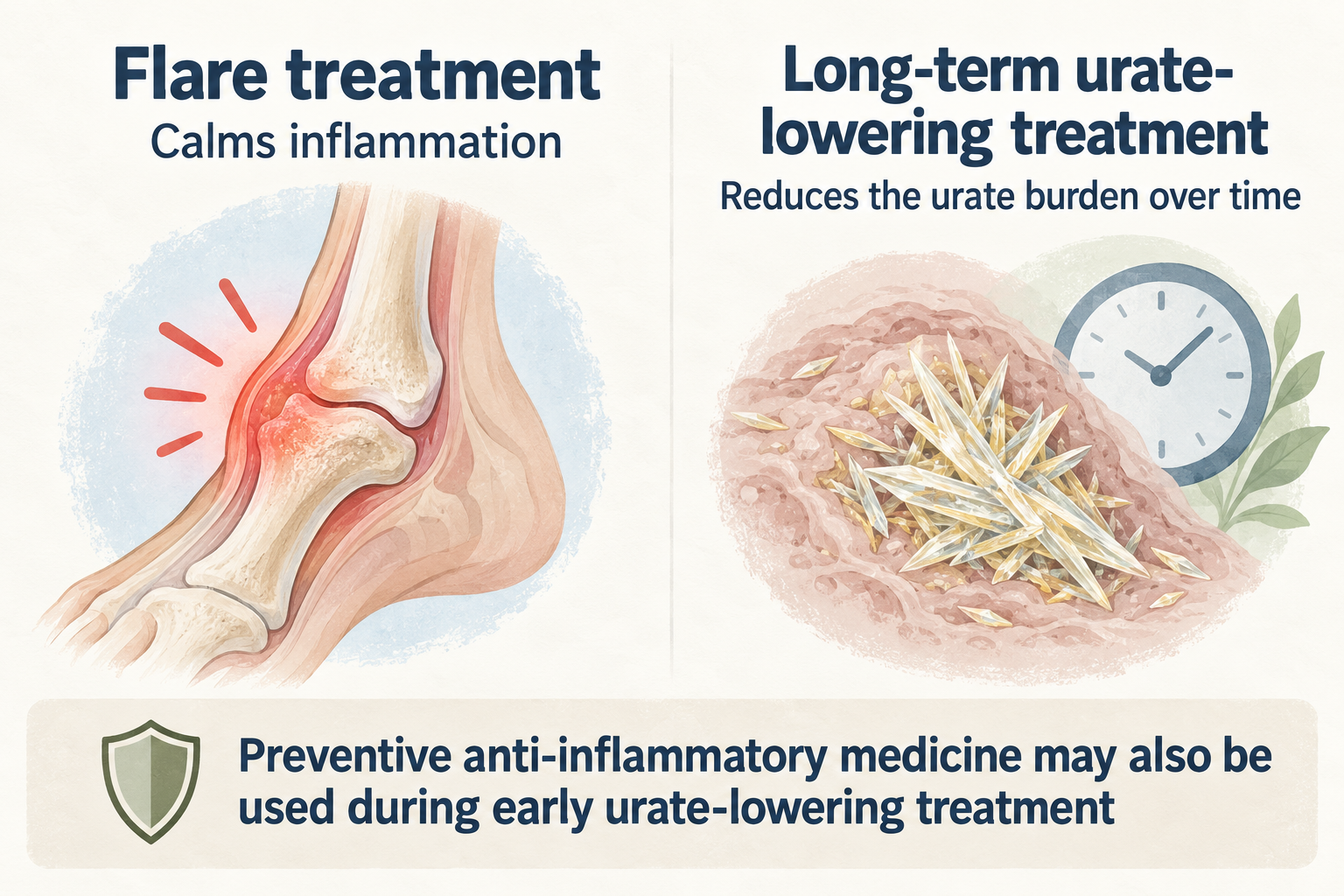
Understand the two treatment jobs
Flare treatment calms inflammation and pain. Urate-lowering treatment addresses the underlying urate burden over time and often continues when someone feels well. Early flares during treatment changes do not automatically mean the medicine should be stopped. S02 S03
Offer help without taking over
Reduce pressure on the inflamed joint and avoid contact that hurts. Do not push activity through severe pain or offer another person’s prescription. Ask whether a lift, a meal, or help with an errand would be useful. S08
Make care information easier to find
With permission, help organize the written flare plan, medicine list, flare dates, blood results, and appointment questions. Include supplements and recent antibiotics in the list because interactions matter. Leave dose changes to the treating team. S03 S10 S20
Do not explain every new symptom as gout
A first hot, swollen joint or changed pattern deserves assessment. Fever, feeling unwell, or worsening symptoms can signal infection; gout and infection can coexist, and infection can occur without fever. Serious medicine reactions also need urgent care. S03 S05 S08
Keep food policing out of support
Gout has several biological contributors. Ask what the person finds difficult rather than inspecting each meal. Problems with pain, treatment side effects, or access may need the care team’s attention. Support sustainable routines and shared decisions, with family involvement guided by the person receiving care. S02 S03
Related pages
- Living with gout
- Preparing a personal flare plan
- When joint symptoms need urgent help
- Emotional health and gout stigma
Sources
- S02: 2020 American College of Rheumatology Guideline for the Management of Gout
- S03: NICE NG219: Gout, diagnosis and management, recommendations
- S05: 2023 EULAR recommendations on imaging in crystal-induced arthropathies
- S08: NHS: Gout
- S10: DailyMed: Colchicine tablets prescribing information
- S20: NCCIH: Using dietary supplements wisely