Gout treatment: flare relief and longer-term control
Prepared 2026-10-29 · Read as Markdown
Gout treatment has different jobs. Flare medicines calm inflammation and pain. Urate-lowering medicines reduce the urate burden over time. Some people also receive an anti-inflammatory to help prevent attacks when long-term treatment is started or adjusted. Knowing which medicine does what makes the plan easier to follow. [S02] [S03]
In this section
Urate-lowering therapy: treating gout over time
Read the practical explanation and supporting sources.
Explore this topicAllopurinol: what it does and what to watch for
Read the practical explanation and supporting sources.
Explore this topicFebuxostat: its role and cardiovascular warning
Read the practical explanation and supporting sources.
Explore this topicProbenecid: helping the kidneys remove urate
Read the practical explanation and supporting sources.
Explore this topicColchicine: follow the exact product and directions
Read the practical explanation and supporting sources.
Explore this topicNSAIDs for a gout flare
Read the practical explanation and supporting sources.
Explore this topicCorticosteroids for a gout flare
Read the practical explanation and supporting sources.
Explore this topicWhen gout needs specialist treatment
Read the practical explanation and supporting sources.
Explore this topicUrate targets, blood tests, and follow-up
Read the practical explanation and supporting sources.
Explore this topicGout medicines: interactions and safety
Read the practical explanation and supporting sources.
Explore this topic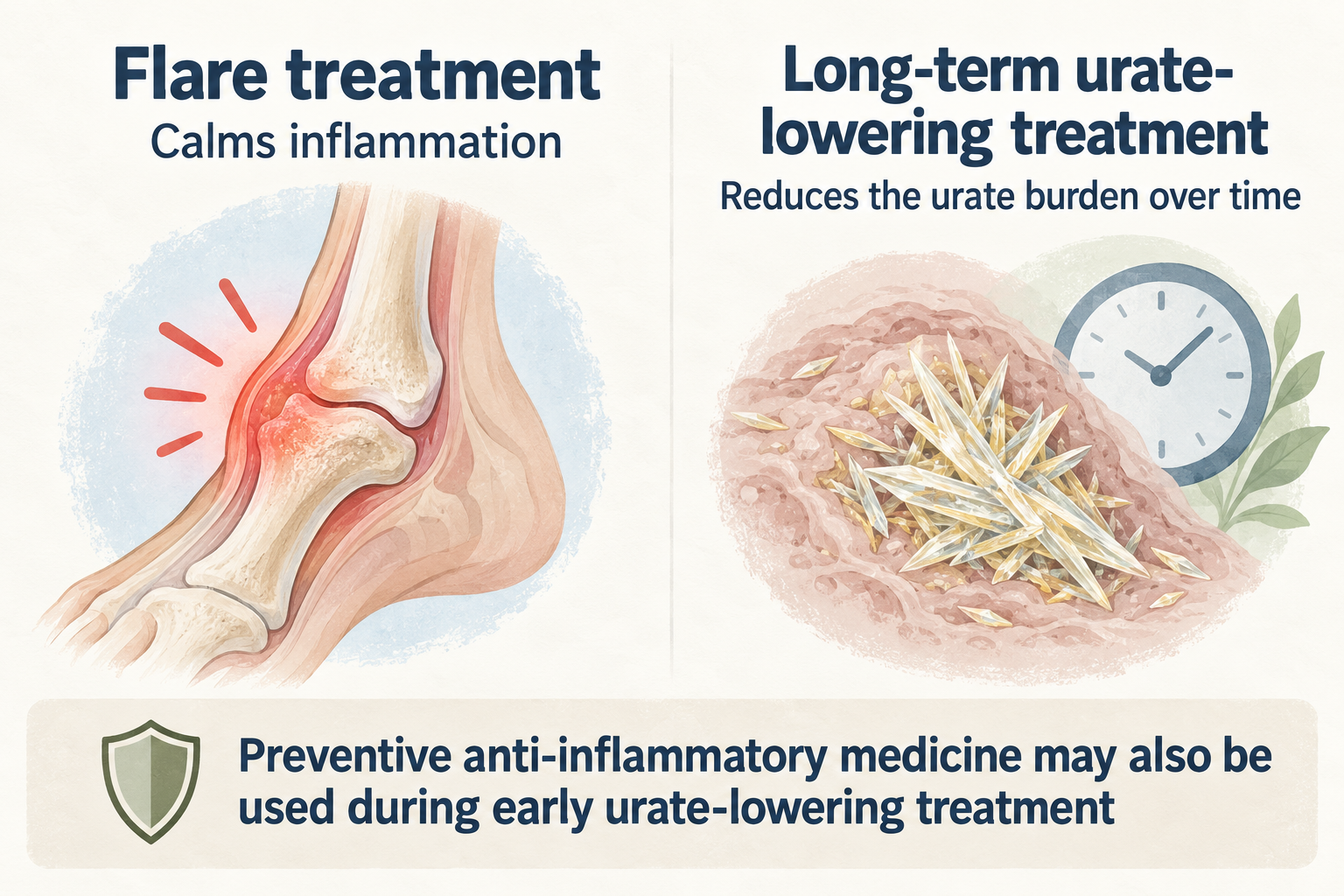
During a flare
Colchicine, NSAIDs, and corticosteroids are common first-line options. Suitability depends on kidney function, other conditions, other medicines, and your preferences. The right choice for someone else may be wrong for you. S02 S03
When to discuss long-term treatment
ACR strongly recommends urate-lowering therapy for tophi, gout-related damage on imaging, or at least two flares a year. Other situations receive conditional recommendations, including some first attacks with kidney disease, very high urate, or stones. NICE uses broader offer-and-discussion criteria. The decision should reflect your disease burden, risks, and priorities. S02 S03
Treatment needs a target and follow-up
Where recommended, clinicians start low and adjust the dose using blood urate and safety checks. A starting dose is not necessarily the dose that will reach target. Early flares can occur as urate changes, so preventive anti-inflammatory treatment is often part of the initial plan. S02
Where the main medicines fit
- Allopurinol: ACR’s preferred initial urate-lowering option, including in chronic kidney disease.
- Febuxostat: another urate-lowering medicine, with a US cardiovascular death boxed warning and a restricted place after allopurinol is unsuitable or inadequate.
- Probenecid: increases urate removal through the kidneys; kidney function, stones, and interactions matter.
- Specialist treatment: options such as pegloticase or selected IL-1 treatment require specialist assessment and monitoring. S02 S11 S12 S13 S14
Leave the appointment knowing the purpose
Ask what each medicine is for, how to take it, what target you are aiming for, what side effects need action, and when the next review is. Bring up costs and access too. A plan has to be workable as well as medically appropriate.
Related pages
- Urate-lowering therapy and prevention
- Allopurinol
- Febuxostat
- Specialist and advanced gout treatment
- Targets, monitoring and follow-up
Sources
- S02: 2020 American College of Rheumatology Guideline for the Management of Gout
- S03: NICE NG219: Gout, diagnosis and management, recommendations
- S11: DailyMed: ULORIC febuxostat prescribing information
- S12: DailyMed: Probenecid tablets prescribing information
- S13: DailyMed: KRYSTEXXA pegloticase prescribing information
- S14: DailyMed: ILARIS canakinumab prescribing information