Natural remedies: a closer look at the evidence
Prepared 2026-10-29 · Read as Markdown
Heard that something helps gout? Start with a more specific question: helps with what? Less pain today, lower blood urate, and fewer attacks over time are different outcomes. Evidence for one cannot automatically establish the others. “Natural” describes an origin or a sales pitch, rather than a proven benefit. [S17] [S20]
In this section
Cherries and tart cherry juice: what do we know?
Read the practical explanation and supporting sources.
Explore this topicVitamin C and supplements marketed for gout
Read the practical explanation and supporting sources.
Explore this topicHerbs, vinegar, and traditional remedies for gout
Read the practical explanation and supporting sources.
Explore this topicHomeopathy and gout: what the evidence supports
Read the practical explanation and supporting sources.
Explore this topicAcupuncture and comfort practices: keep the goal clear
Read the practical explanation and supporting sources.
Explore this topic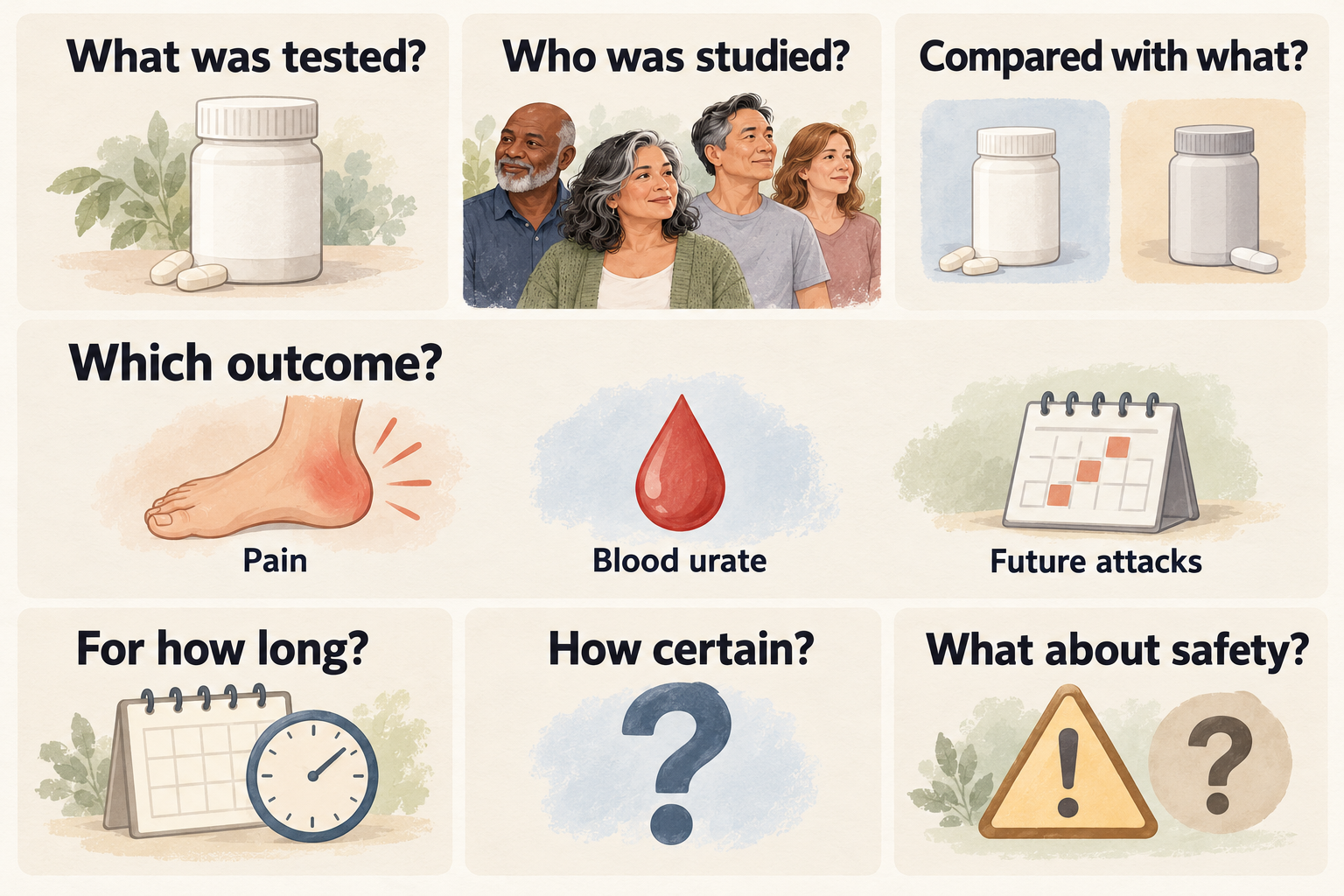
Keep the categories separate
Food choices, home comfort measures, supplements, herbs, acupuncture, and homeopathy are different approaches. Look at the exact product or practice and what was actually studied. A testimonial can make something sound like a sure thing without answering those questions. S17 S20
What already has a practical role
Rest, protecting the joint, and wrapped cold packs can support comfort alongside treatment. Balanced eating and appropriate weight management can support overall care. Evidence does not establish a particular diet as a reliable substitute for needed urate-lowering treatment. S02 S03 S08 S15
What about popular products?
Cherry evidence is limited and mixed; a small randomized trial did not show urate lowering. ACR conditionally advises against adding vitamin C specifically for gout. Herbal and supplement studies often have important quality and standardization limits. None of this establishes a universal supplement dose or a “gout cleanse.” S02 S16 S21
Homeopathy needs its own assessment
A pilot without a placebo or usual-care-only group cannot isolate treatment effects. A small placebo-controlled adjunctive conference report did not show a quality-of-life advantage. Alongside NCCIH’s broader assessment, the evidence does not support recommending homeopathy for gout. Some products can still contain active ingredients. S17 S18 S19
Bring these questions to a pharmacist or clinician
What exactly is in the product? Is there reliable human evidence for this use? Could it interact with my medicines or affect kidney or liver health? Would using it delay assessment or effective treatment? Bring the actual packaging so the discussion is about the product you have. S20
Related pages
- Cherries and tart cherry products
- Vitamin C and other dietary supplements
- Herbs, vinegar and traditional remedies
- Homeopathy and gout: evidence and limits
- Acupuncture and other comfort practices
Sources
- S02: 2020 American College of Rheumatology Guideline for the Management of Gout
- S03: NICE NG219: Gout, diagnosis and management, recommendations
- S08: NHS: Gout
- S15: NICE Evidence Review I: Diet and lifestyle modifications for gout
- S16: Stamp et al.: Lack of effect of tart cherry concentrate dose on serum urate in people with gout
- S17: NCCIH: Homeopathy
- S18: Nayak et al.: Individualized homeopathic medicines and Urtica urens mother tincture in hyperuricemia
- S19: Sahani et al.: Individualized homeopathy as an adjunct in gout, randomized placebo-controlled trial
- S20: NCCIH: Using dietary supplements wisely
- S21: Yang et al.: Natural product dietary supplements in gout, systematic review and meta-analysis