Acupuncture and comfort practices: keep the goal clear
Prepared 2026-10-29 · Read as Markdown
Relief, relaxation, better function, and fewer future gout attacks are different goals. Evidence for one does not automatically establish another. A practice offered for comfort should not be described as dissolving crystals without direct evidence. [S02] [S21]
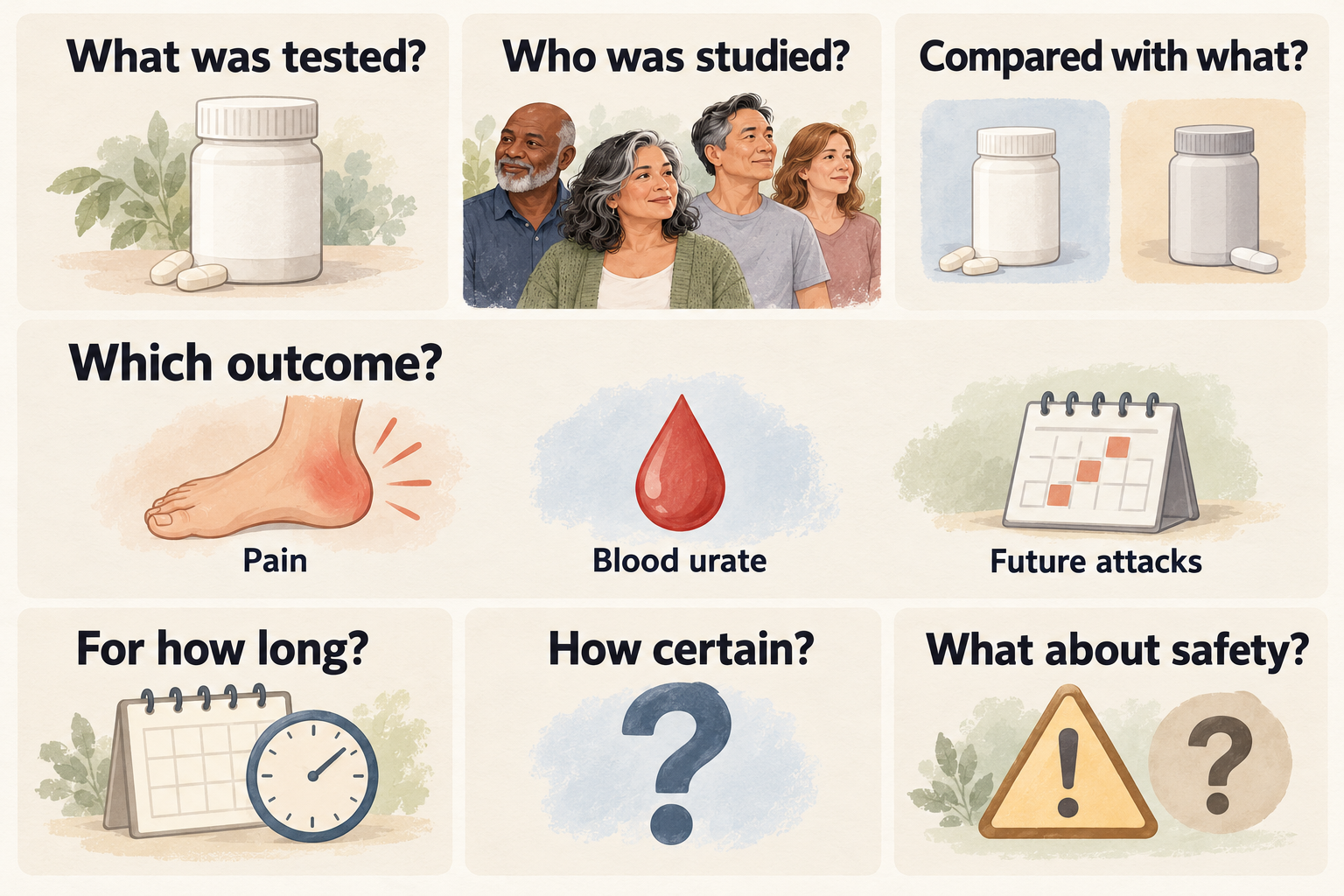
Acupuncture evidence remains uncertain here
Reviews have reported possible pain or urate effects, but the newer reviews identified in this project were not fully appraised. Trial quality, comparison treatments, blinding, mixed populations, co-treatment, and follow-up all need closer examination. This page therefore cannot recommend an acupuncture schedule as gout treatment.
That is an evidence gap in this review, rather than a claim that every study has shown no effect.
Assessment comes first
Have a hot, painful, swollen joint assessed before using a procedure to manage it. Temporary pain improvement cannot exclude infection. Needle-based treatment needs appropriate qualified practice and consideration of your conditions and medicines; specific safety advice requires a dedicated review. S03 S05
Some comfort measures have a clearer role
Rest, protection from pressure, and a wrapped cold pack have a place in guideline-supported flare care alongside treatment. Relaxation, sleep routines, and practical help may support coping, but should not be presented as ways to lower urate or independently prevent attacks. S03 S08
Questions worth asking
What outcome was studied? Was the comparison credible? Were participants diagnosed with gout, or did they only have high urate? What other treatment did they receive? Were harms and longer-term results measured?
Until those questions are answered adequately, keep claims limited and maintain the underlying gout plan and urgent-care guidance.
Related pages
- Home care and pain support
- Natural remedies, complementary approaches and homeopathy
- When joint symptoms need urgent help
- Emotional health and gout stigma
Sources
- S02: 2020 American College of Rheumatology Guideline for the Management of Gout
- S03: NICE NG219: Gout, diagnosis and management, recommendations
- S05: 2023 EULAR recommendations on imaging in crystal-induced arthropathies
- S08: NHS: Gout
- S21: Yang et al.: Natural product dietary supplements in gout, systematic review and meta-analysis