Urate-lowering therapy: treating gout over time
Prepared 2026-10-29 · Read as Markdown
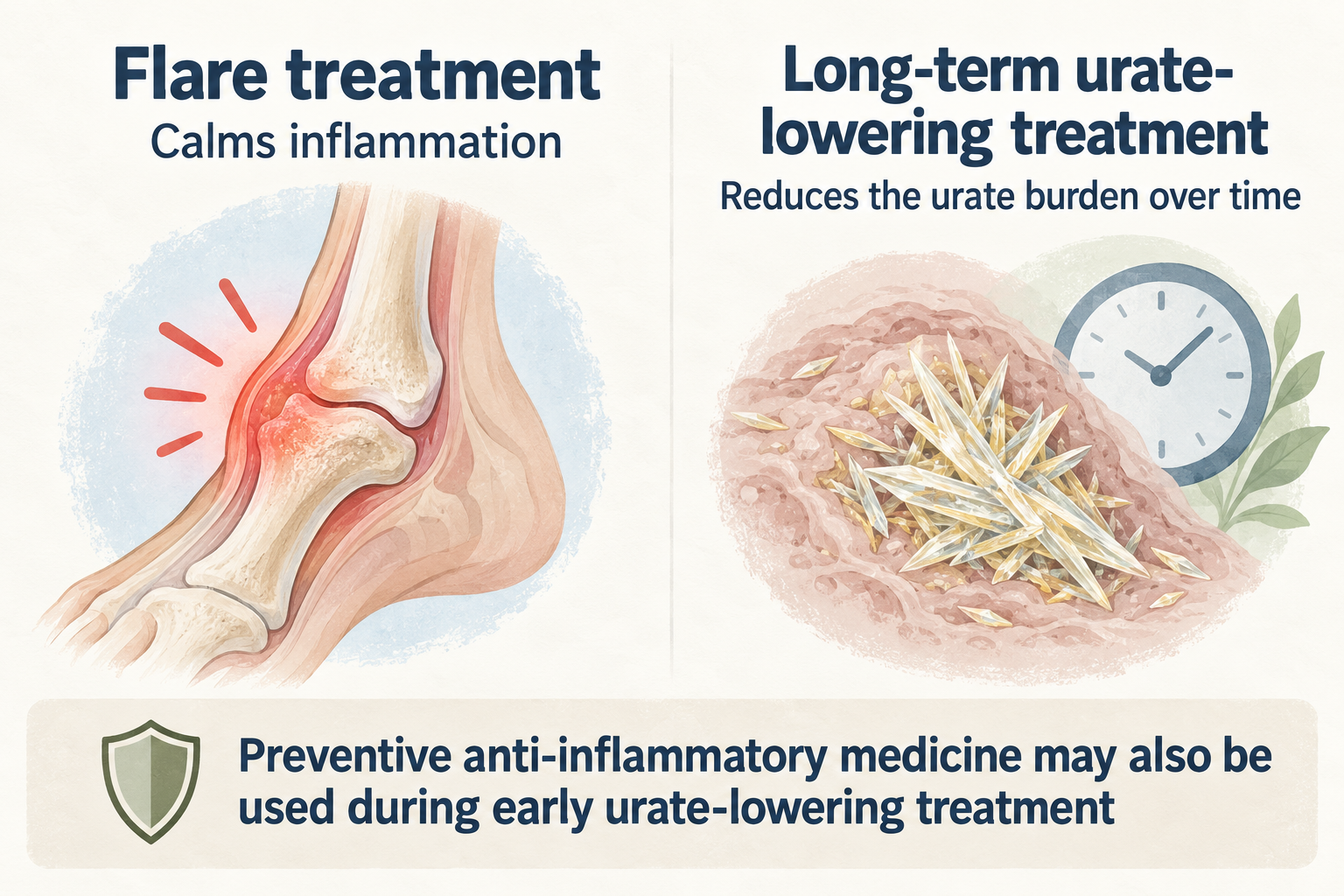
Urate-lowering therapy, or ULT, treats the urate burden behind gout. Sustained lowering helps create conditions in which deposits can dissolve, with goals including fewer future flares, smaller tophi, and prevention of further gout-related joint damage. It works over time; a flare settling is not proof that deposits have gone. [S02] [S03]
Who should discuss it?
ACR strongly recommends ULT for tophi, gout-related imaging damage, or two or more flares a year. It conditionally favors treatment after more than one but infrequent attacks. After a first attack it generally advises against routine initiation, with exceptions including CKD stage 3 or greater, urate above 9 mg/dL, or urinary stones. S02
NICE offers ULT for multiple or troublesome flares, CKD stages 3–5, diuretic therapy, tophi, or chronic gouty arthritis, and discusses it more broadly after a flare. These are different guideline approaches, rather than one universal rule. S03
Agree a target
The usual target is below 6 mg/dL, approximately 360 µmol/L. NICE considers a lower target for some severe or persistent disease. Your clinician adjusts treatment using repeat results and safety review, rather than symptoms alone. Preventive anti-inflammatory medicine may help during the early treatment period. S02 S03
Ask when to start—and what to continue
ACR conditionally favors starting indicated ULT during a flare. NICE usually starts at least two to four weeks after it settles, with an option to start during frequent flares. Your clinician should explain the approach and the product-specific instructions. S02 S03
An ordinary flare usually does not mean stopping existing allopurinol. A new rash or suspected hypersensitivity is different: stop it and seek prompt medical advice. Severe skin symptoms, swelling, breathing difficulty, or severe illness require emergency care. S09
Expect a continuing plan
ULT is usually continued after target is reached and is often lifelong. Blood levels and existing deposits change on different timescales. Continued early attacks call for review of the target, preventive treatment, medicine access and use, and the diagnosis—not an automatic decision that treatment has failed. S02 S03
Related pages
- Allopurinol
- Targets, monitoring and follow-up
- Stages and progression
- Preparing a personal flare plan