How gout can change over time
Prepared 2026-10-29 · Read as Markdown
Gout does not follow the same timetable for everyone. Some people have long gaps between attacks; others develop frequent flares or persistent joint problems. Understanding the stages helps explain why treatment may still matter when the joint feels quiet. [S03] [S06]
Before a first recognized flare
Blood urate can be high for years without symptoms. Some people have crystal deposits on imaging before a recognized attack. Neither situation is automatically the same as symptomatic gout. ACR conditionally recommends against routinely starting gout urate-lowering medicines for asymptomatic hyperuricemia. A high result deserves context, not an automatic prescription. S02
Flares and the quiet stretches
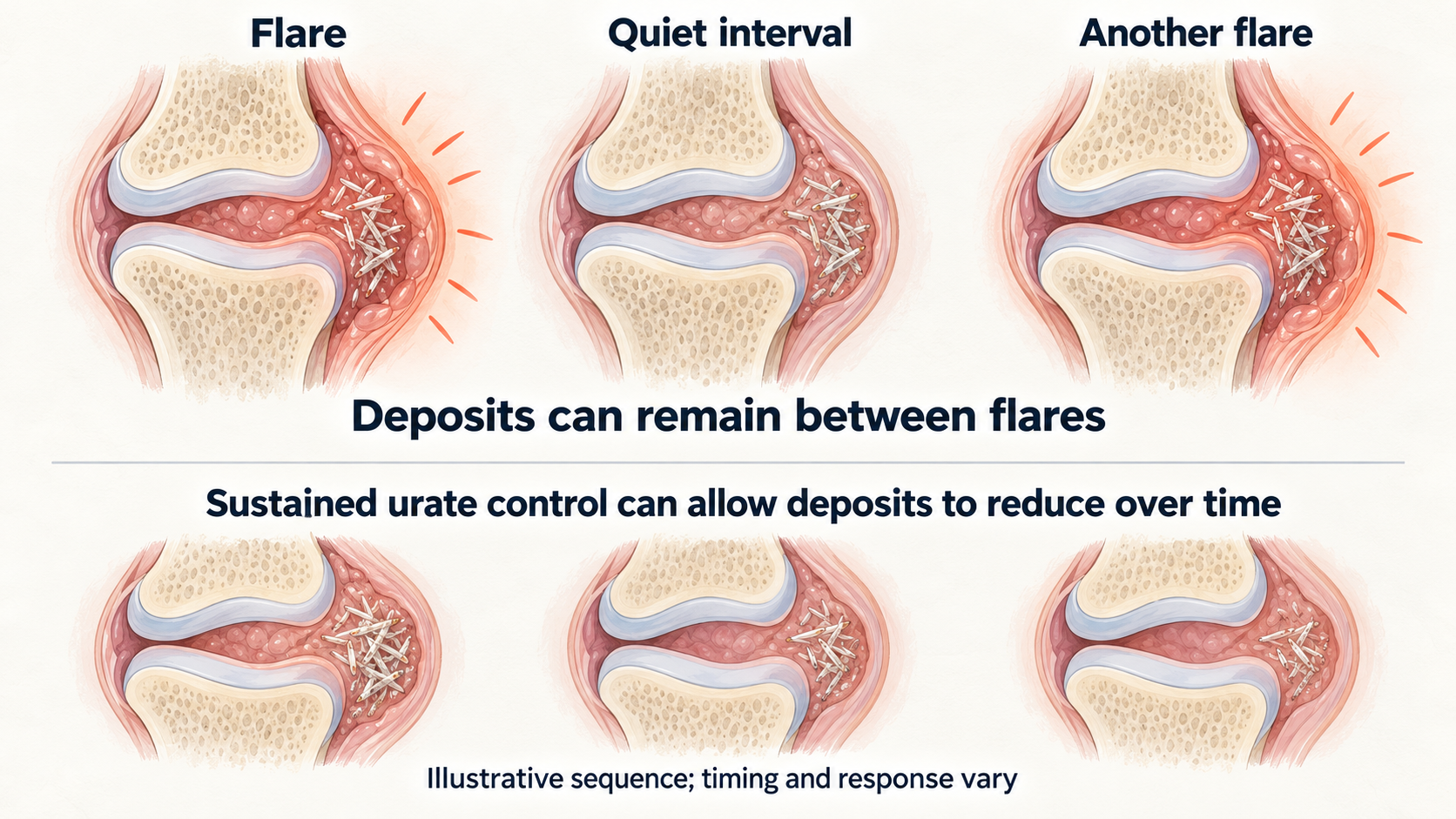
An early flare often affects one joint and settles over days to a couple of weeks. The interval between attacks is called intercritical gout. Symptoms easing does not show that the deposits have disappeared. S06 S08
When problems become more persistent
Without adequate control, attacks may become more frequent or involve more joints. Deposits called tophi can develop in soft tissues and affect movement or skin. Chronic gout can also cause joint damage and ongoing arthritis. Have a new lump examined rather than deciding what it is from a photograph. S03 S06
Treatment can change the course
Sustained urate lowering aims to allow deposits to dissolve, reduce future attacks, and shrink tophi. How quickly that happens depends partly on the starting burden and how long urate stays controlled. Flares can still occur early in treatment, so they do not automatically mean it has failed. S02 S03
Feeling well is a goal—and a reason to keep reviewing
Long-term treatment is commonly continued after the blood target is reached. Discuss changes or stopping with your clinician. A useful review includes urate results, flares, movement, tophi, side effects, and how manageable the plan is in everyday life. S02 S03
Related pages
- Urate-lowering therapy and prevention
- Tophi, chronic gout and joint damage
- Targets, monitoring and follow-up
- Common gout misconceptions