Tophi and gout-related joint damage
Prepared 2026-10-29 · Read as Markdown
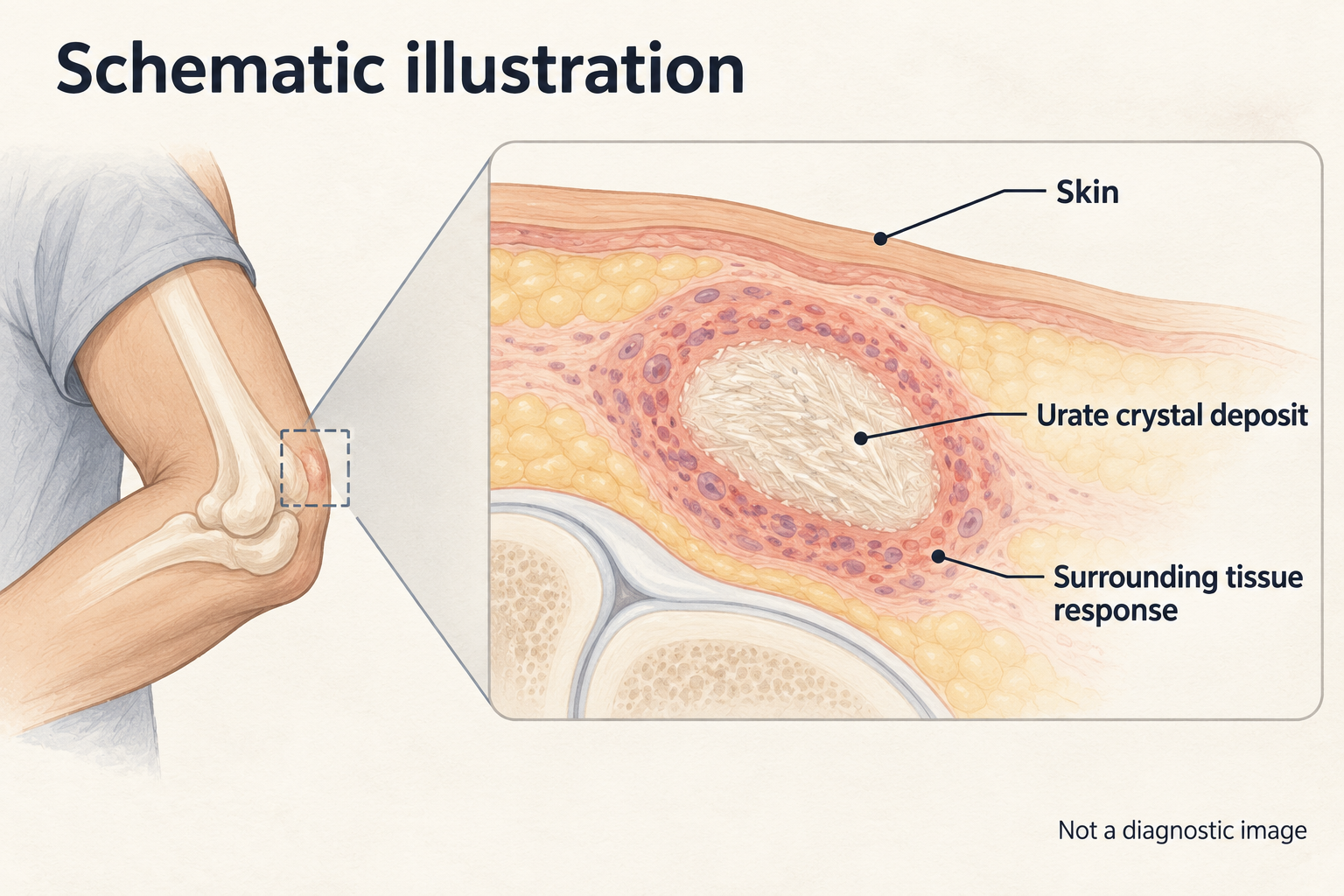
Tophi are organized deposits of urate crystals with a surrounding tissue response. They can form beneath the skin, around joints, or in other tissues. Some start out painless, but can interfere with movement, damage tissue, or change joint shape. A lump needs assessment; its appearance alone does not establish what it is. [S06]
Why tophi change the treatment conversation
ACR strongly recommends urate-lowering treatment for subcutaneous tophi or imaging damage caused by gout. NICE considers a lower urate target below 300 µmol/L (5 mg/dL) with tophi or chronic gouty arthritis. Deposits take time and sustained control to shrink. A target blood result does not mean a large deposit will disappear immediately. S02 S03
Report changes in skin and function
Tell your clinician about changes in size, pain, movement, or footwear tolerance. Broken or draining skin, a newly hot or red area, fever, or worsening symptoms needs assessment for complications including infection. Do not cut, drain, or attempt to dissolve a lump at home. S03 S05
Persistent disease deserves a wider review
Review diagnostic confidence, the target, dose adjustment, access, and medicine use. Pegloticase may be considered for selected refractory chronic gout under specialist care, with important infusion, allergic-reaction, and G6PD precautions. Some complications may also need surgical or wound assessment. S03 S13
How to interpret images
Photographs show specific cases, not a diagnostic matching exercise or a forecast of what will happen to you. Tissue microscopy is a different kind of view again. Neither should be used to judge severity or treatment prospects without clinical context.
Related pages
- Specialist and advanced gout treatment
- Stages and progression
- Targets, monitoring and follow-up
- Movement, footwear and recovery
Sources
- S02: 2020 American College of Rheumatology Guideline for the Management of Gout
- S03: NICE NG219: Gout, diagnosis and management, recommendations
- S05: 2023 EULAR recommendations on imaging in crystal-induced arthropathies
- S06: NIAMS: Gout overview, symptoms, causes and risk factors
- S13: DailyMed: KRYSTEXXA pegloticase prescribing information