Where gout can occur
Prepared 2026-10-29 · Read as Markdown
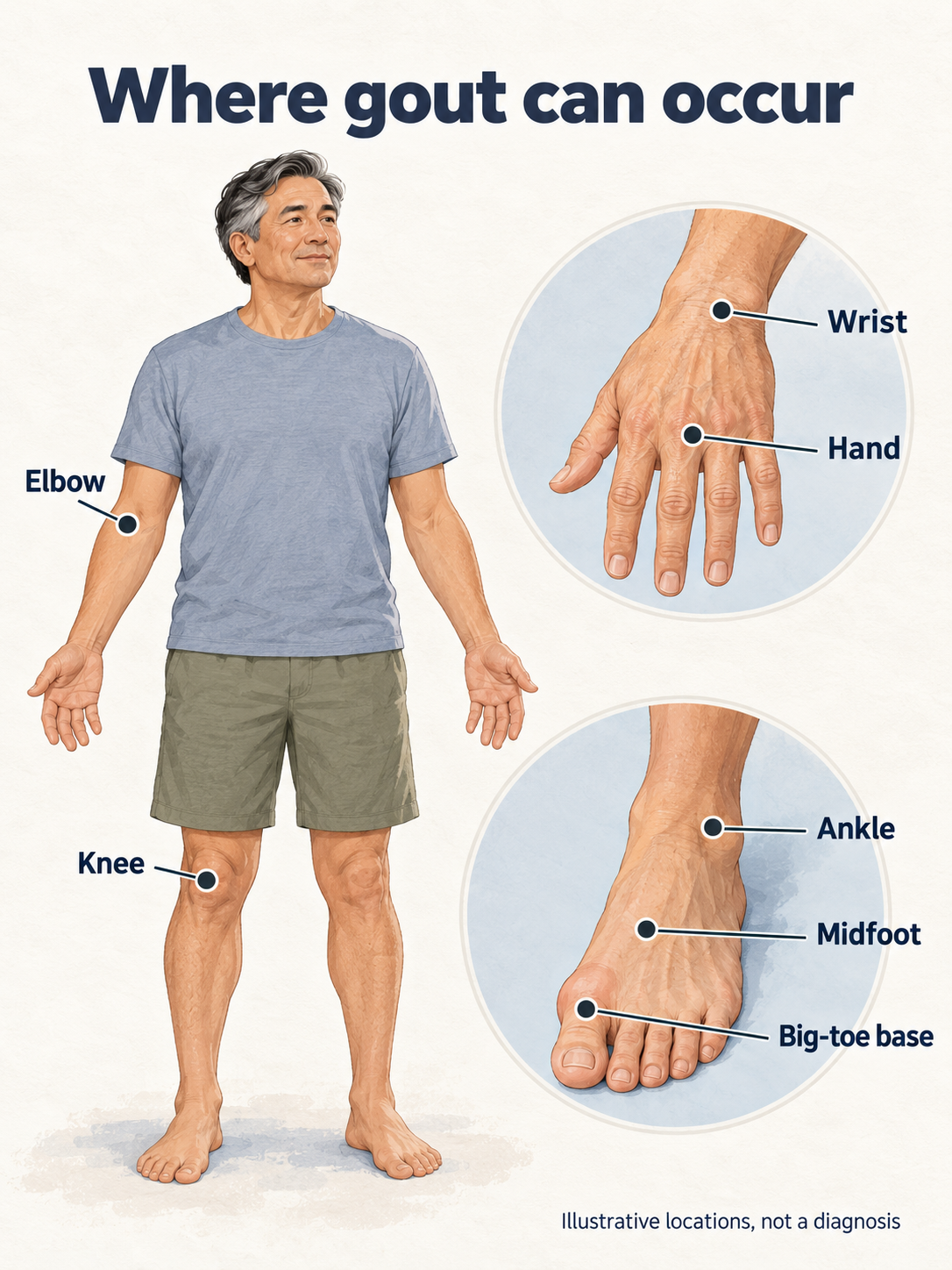
The joint at the base of the big toe is a familiar starting point for gout, but gout is not limited to toes. It can affect the midfoot, ankles, knees, hands, wrists, and elbows, sometimes in more than one joint. Where it hurts helps a clinician assess the problem; location alone cannot diagnose it. [S03] [S06]
It can involve tissues around a joint
Gout can affect bursae—the small cushions between tissues—and tendon sheaths. Crystal deposits called tophi can develop around joints and in other soft tissues. Their size and location may interfere with movement even without a dramatic flare. A persistent lump or unexplained swelling needs examination. S06
A photograph has limits
A photo may help you record swelling or show how an area has changed. It cannot reveal everything happening inside a joint or exclude infection. Redness also varies with skin tone and lighting. Matching your foot to a picture online is not a reliable diagnostic test. S03 S08
Describe the location as precisely as you can
Point to the affected area and explain whether pain seems centered on the joint or the surrounding tissue. Note whether one or both sides are involved, how quickly it started, and whether there was an injury. Mention surgery, joint replacement, or a recent injection. S03 S05
A new pattern deserves attention
A first hot, swollen joint needs assessment. So does an episode that feels different from your established gout pattern. Fever, feeling unwell, or rapidly worsening symptoms make urgent help particularly important. Knowing you have gout does not rule out another problem. S03 S05
Related pages
- Symptoms of gout
- Conditions that can look like gout
- Tophi, chronic gout and joint damage
- When joint symptoms need urgent help