Understanding purines in food
Prepared 2026-10-29 · Read as Markdown
Purines are normal compounds in cells and many foods. Your body breaks them down as part of urate production, but food is not the only source: your own cells contribute too. Trying to eliminate every detectable purine would be impractical and would still leave out much of the explanation for gout. [S27] [S29]
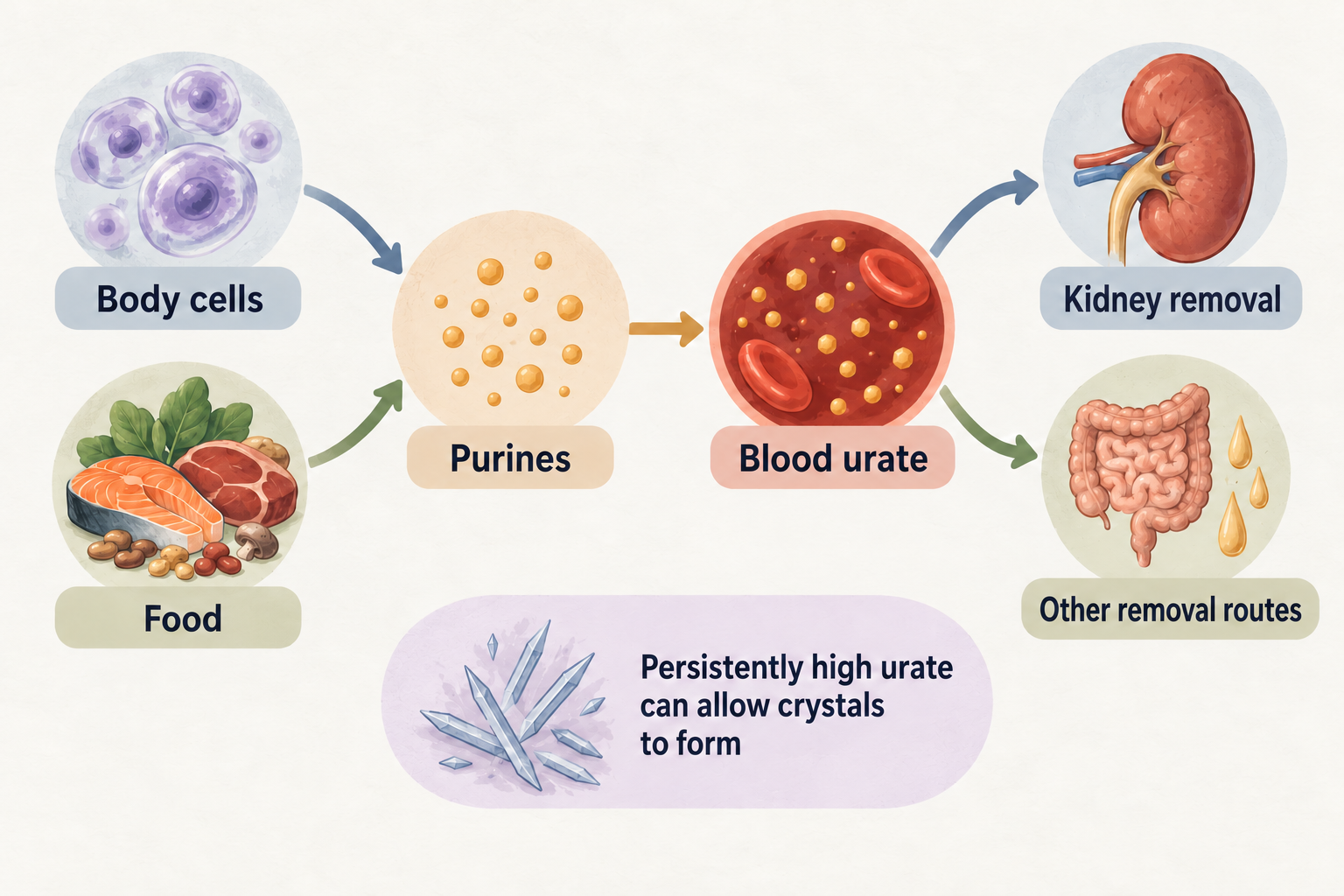
What a food-table number measures
Food tests commonly measure adenine, guanine, hypoxanthine, and xanthine, then add them for total purines. Preparation, water content, and composition affect the result. A dried ingredient may look concentrated per 100 grams even if you use only a small amount. A raw record should not stand in for a cooked one. S27 S29
Some older references report calculated uric-acid equivalents. Those cannot be merged directly with measured total purines as if the units meant the same thing. S27 S29
A number is not a food verdict
Purine-rich vegetables and animal-source foods have different observed associations with gout. Treating spinach and organ meat as clinically equivalent because both contain purines misses that distinction. Strong intervention evidence for strict gout diets is also limited. S15 S30
There is no universal daily allowance here
The Kaneko paper discusses Japanese advice to keep dietary purines below 400 mg daily. That regional context is not a universal US target adopted by ACR or NICE. We do not use it to calculate a personal allowance or stamp foods safe and unsafe. S02 S03 S29
Estimate a portion carefully
For a numeric value for a matching solid food:
Estimated portion purines = mg per 100 g × portion weight in grams ÷ 100.
Keep the exact description, preparation, country, and sample information in view. Missing values and “not detected” are not interchangeable with measured zero. The complete table keeps these distinctions visible. S27 S28
Related pages
- Uric acid, urate and purines
- Purine content of foods: complete measured reference
- Food and drink with gout
- Meal planning and food substitutions
Sources
- S02: 2020 American College of Rheumatology Guideline for the Management of Gout
- S03: NICE NG219: Gout, diagnosis and management, recommendations
- S15: NICE Evidence Review I: Diet and lifestyle modifications for gout
- S27: USDA/ODS-NIH purine database documentation Release 3.0
- S28: USDA/ODS-NIH purine database and data sources Release 3.0
- S29: Kaneko et al.: Total purine and purine base content of common foodstuffs
- S30: InformedHealth/IQWiG: What can I do on my own to prevent gout attacks?