Uric acid, urate, and purines: what’s the difference?
Prepared 2026-10-29 · Read as Markdown
The names can make a straightforward explanation sound like a chemistry exam. Here is the useful distinction: purines are broken down to make uric acid, which is mostly present as urate in the body. Blood-test reports often call the measurement “uric acid.” [S27] [S29]
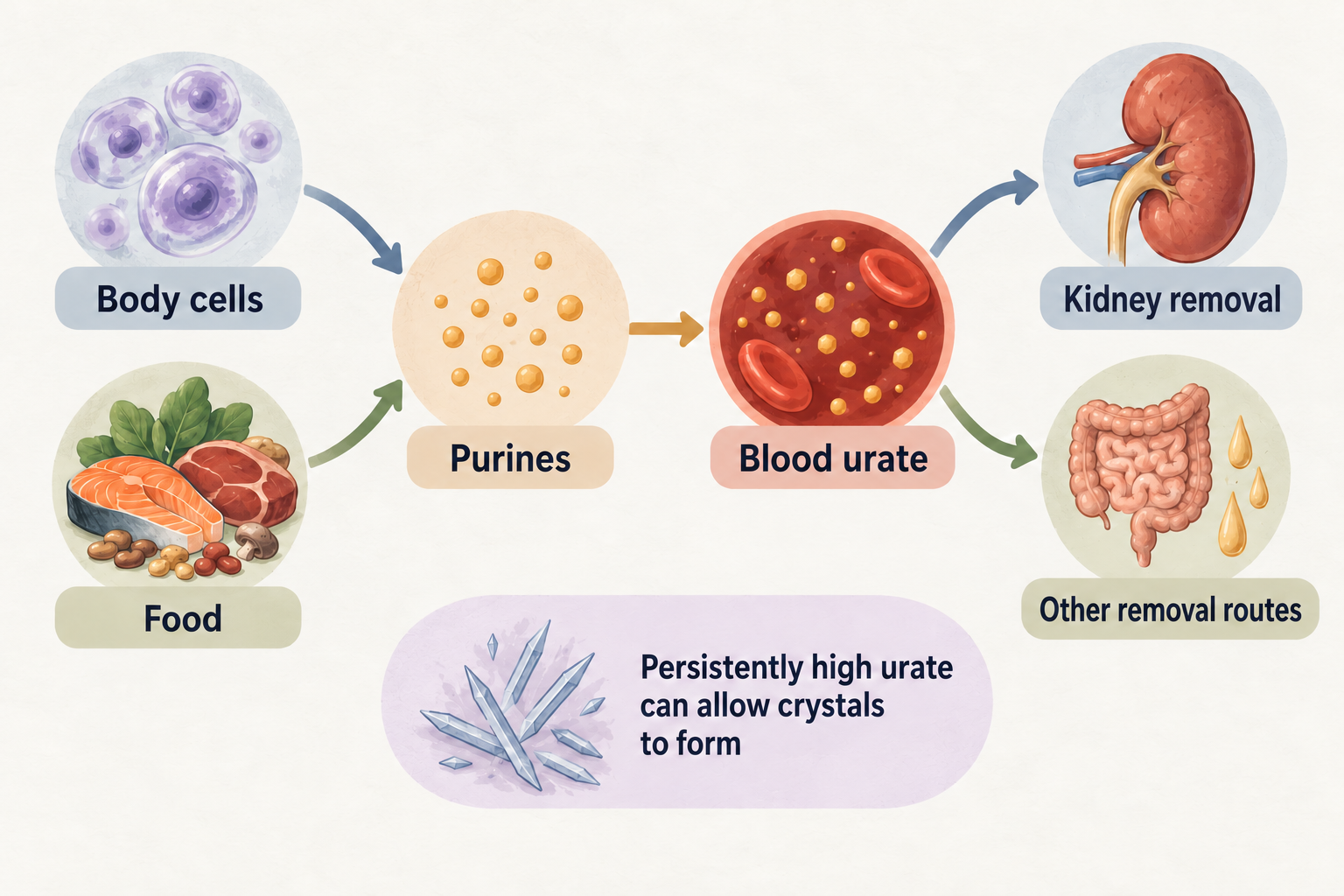
Purines come from your body and your food
Purines are normal parts of cellular molecules, including DNA and RNA. Your body’s own cell turnover contributes to urate production, as does food. A purine count therefore tells you something about a food; it does not explain everything about a person’s blood result. S06 S27
When urate becomes a joint problem
Persistently high urate makes crystal formation more likely. In gout, monosodium urate crystals collect in tissues and can provoke inflammation. Some people have high blood urate without gout, so a result needs to be interpreted alongside symptoms and the rest of the assessment. S06
Your blood result and a food number use different units
Blood results commonly use mg/dL or µmol/L. Food-composition values in this site’s reference use mg per 100 g for foods and mg per 100 mL for beverages. They measure different things. A food value cannot be compared directly with your blood result. S03 S27 S28
Why treatment targets matter
For people receiving urate-lowering treatment for gout, the usual target is below 6 mg/dL, approximately 360 µmol/L in guideline convention. NICE considers a lower target for some people with more severe or persistent disease. Your clinician should explain the target and how progress will be monitored. S02 S03
A lower blood result and the disappearance of existing deposits happen on different timescales. That is one reason follow-up looks at flares and function as well as a number. S02 S03
Related pages
- Understanding dietary purines
- Purine content of foods: complete measured reference
- Blood tests, joint fluid and imaging
- Targets, monitoring and follow-up
Sources
- S02: 2020 American College of Rheumatology Guideline for the Management of Gout
- S03: NICE NG219: Gout, diagnosis and management, recommendations
- S06: NIAMS: Gout overview, symptoms, causes and risk factors
- S27: USDA/ODS-NIH purine database documentation Release 3.0
- S28: USDA/ODS-NIH purine database and data sources Release 3.0
- S29: Kaneko et al.: Total purine and purine base content of common foodstuffs