Blood tests, joint fluid, and imaging
Prepared 2026-10-29 · Read as Markdown
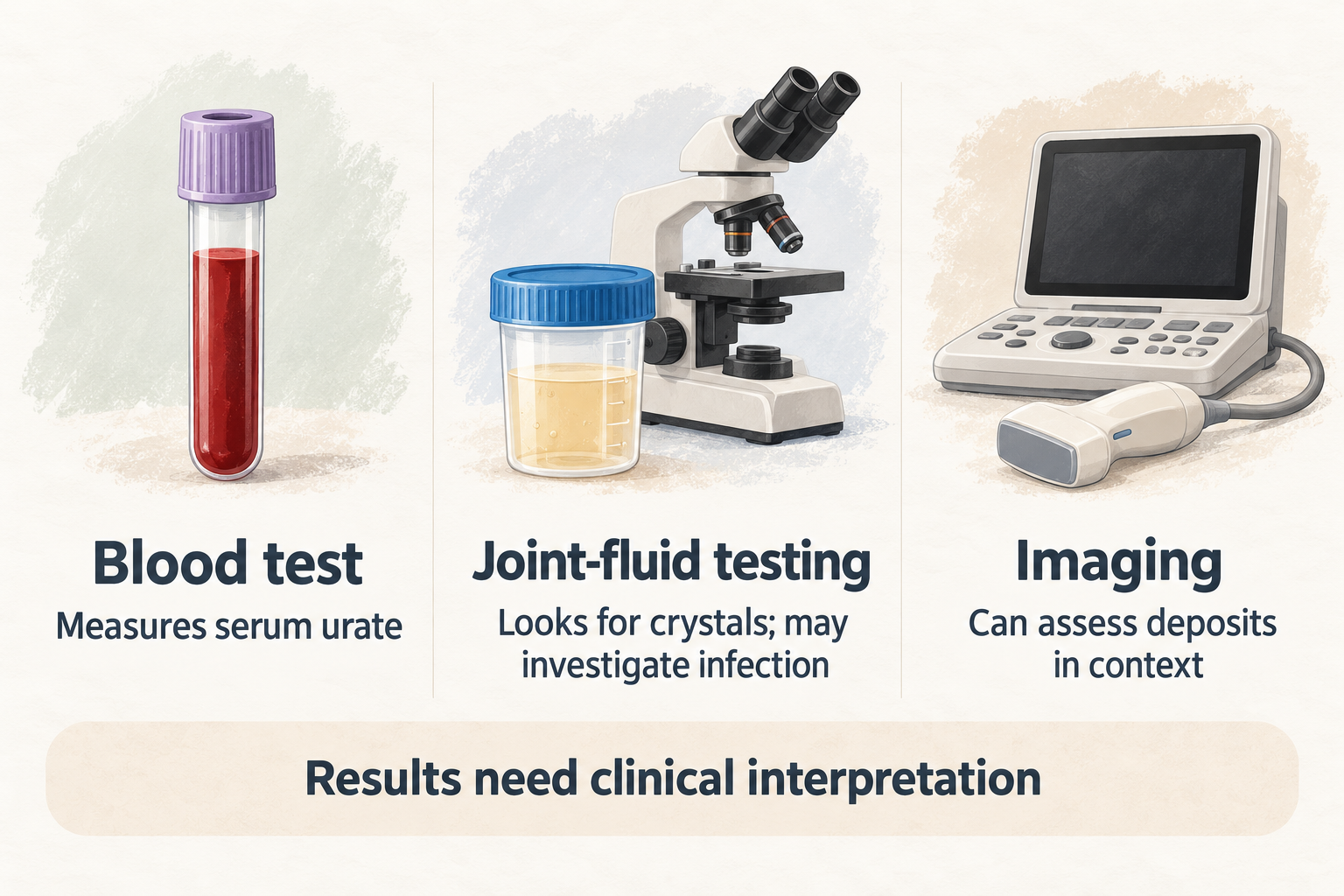
Different tests answer different questions. A urate result measures what is circulating in your blood; joint fluid can reveal crystals or help investigate infection; imaging can show deposits or damage. Your clinician chooses tests to resolve the question at hand. [S03] [S05]
Keep the actual blood-test report
Record the value, date, unit, and whether you were having a flare. “Normal” and “high” leave out useful detail. A laboratory reference range is different from a treatment target, and a lower urate result during an attack may need repeating after recovery. S02 S03
Blood urate commonly uses mg/dL or µmol/L. Food tables use different units, such as mg per 100 g. Those numbers cannot be compared directly. S03 S27
Other blood tests may guide safe treatment
Kidney function can affect medicine choices. The allopurinol label calls for baseline urate, blood count, chemistry, liver, and kidney assessment. Additional tests depend on the medicine and your circumstances. Inflammatory markers may support an assessment, but are not a unique signature of gout. S03 S09
What joint fluid adds
Microscopy looks for crystals. Microbiology investigates infection where relevant. Your clinician decides which analyses are needed. Crystals and infection can coexist, so one finding does not cancel the need to assess the other. S05
What imaging adds
Ultrasound can show characteristic deposits and inflammation. DECT helps identify material consistent with urate. X-rays are useful for chronic damage but may show little early on. All need interpretation in context; no scan is a universal answer to every painful joint. S03 S05
Useful questions at the appointment
- What is the diagnosis based on, and was infection considered?
- Should urate be measured again after the flare?
- What target applies to me?
- Are kidney or liver results affecting treatment?
- When should we review the results?
Related pages
- Uric acid, urate and purines
- Targets, monitoring and follow-up
- How gout is diagnosed
- Diagnostic reference and differential assessment
Sources
- S02: 2020 American College of Rheumatology Guideline for the Management of Gout
- S03: NICE NG219: Gout, diagnosis and management, recommendations
- S05: 2023 EULAR recommendations on imaging in crystal-induced arthropathies
- S09: DailyMed: Allopurinol tablets prescribing information
- S27: USDA/ODS-NIH purine database documentation Release 3.0