How gout is diagnosed
Prepared 2026-10-29 · Read as Markdown
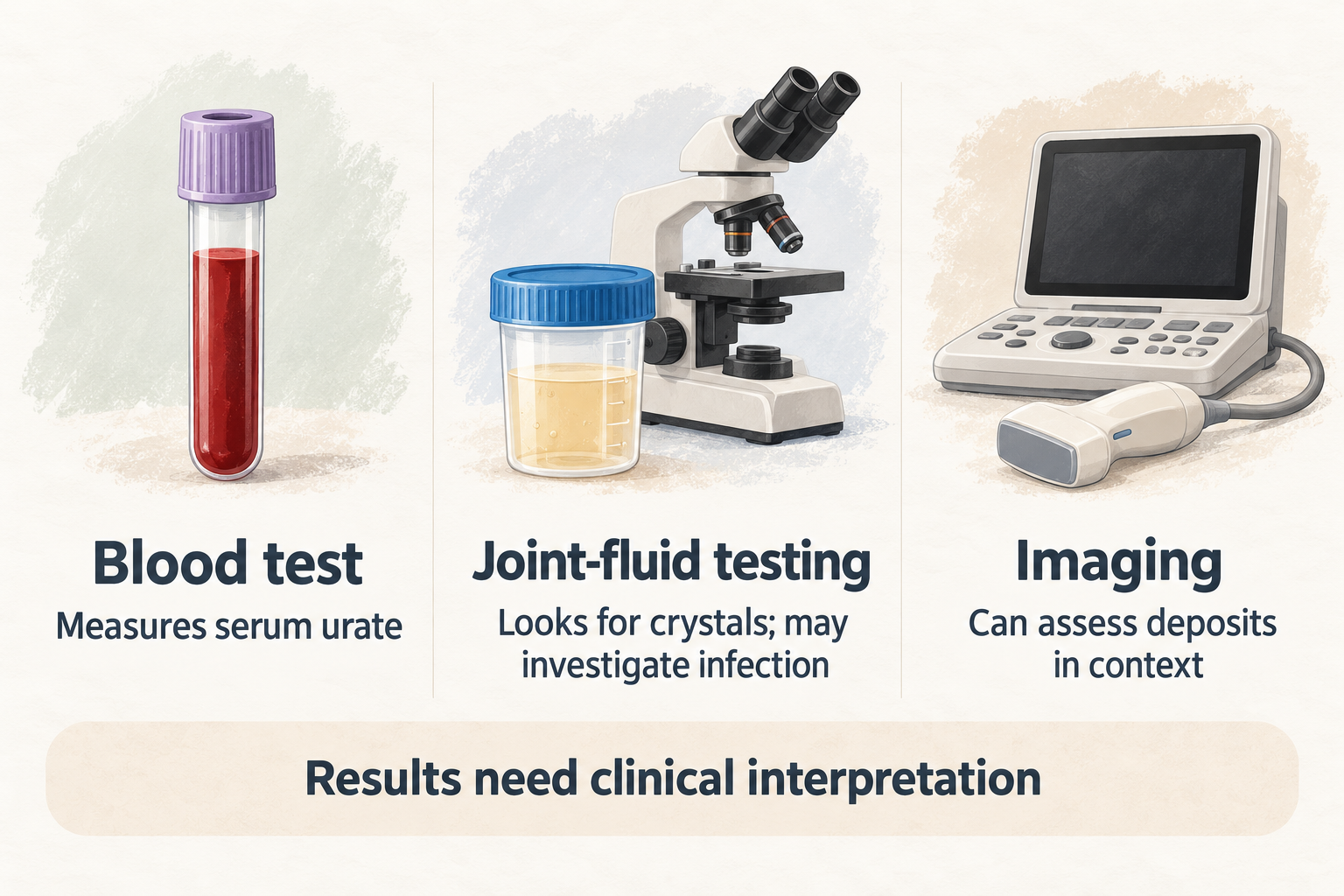
Gout is diagnosed from the whole picture: your symptoms, examination, history, and sometimes blood tests, joint-fluid testing, or imaging. A classic big-toe attack raises suspicion, but it does not remove the need to consider infection and other causes. [S03]
The questions help establish the pattern
Expect questions about how quickly pain started, affected joints, previous episodes, lumps, medicines, and other health conditions. A first attack, unusual symptoms, or treatment that is not helping deserves particular attention. S03
What a urate blood test can tell you
The result supports an assessment; it is not a diagnosis by itself. Some people have high urate without gout. During a flare, urate can be lower than expected. NICE advises repeating a result below 360 µmol/L (6 mg/dL) at least two weeks after the flare settles if gout remains strongly suspected. S03 S06
Why a clinician may take joint fluid
Joint aspiration removes a small sample for laboratory examination. Identifying monosodium urate crystals establishes crystal deposition. If infection is possible, the fluid also needs the appropriate infection assessment: finding crystals does not rule infection out. Sampling and interpretation have limits, so a negative or unsuccessful test may leave questions unresolved. S03 S05
Where scans fit
Ultrasound can show deposits and inflammation. Dual-energy CT, or DECT, can identify material consistent with urate deposits. X-rays may show chronic damage but can be unrevealing early. The usefulness of each test depends on the circumstances and expert interpretation. S03 S05
When to revisit the diagnosis
Ask for review if the course does not fit expectations. NICE recommends considering rheumatology referral for diagnostic uncertainty, unsuitable or ineffective treatment, advanced kidney disease, or organ transplantation. Research classification criteria are not a substitute for your individual assessment. S03
Related pages
- Blood tests, joint fluid and imaging
- Conditions that can look like gout
- Diagnostic reference and differential assessment
- Appointments, treatment access and your care team